Phased Learning Model for New AfterSales Onboarding
Overview
This proposal reflects how I approach onboarding design. Our current AfterSales onboarding model follows a familiar format where the assumption is that new hires need to know everything before they transition to the floor. Observing the outcomes of this approach as both a Delivery Specialist and a former new hire, it was clear that this approach has its shortcomings.
The solution I'm proposing isn't more training. It's a different structure for when and how training happens.
Our current onboarding model front-loads everything. New hires are expected to absorb a dense, month-long curriculum and emerge ready to handle any scenario they encounter. The issue with this approach:
Learners hit the floor overwhelmed. They understood the material in training but lose confidence the moment real cases arrive. The volume of information delivered in a compressed window creates cognitive overload.
Leadership expectations go unmet. Seniors and Supervisors expect new reps to perform independently immediately after training. When they don't, the gap is attributed to the rep rather than the training model.
The issue isn't the content. It's the structure. Front-loading all knowledge into a single training window limits meaningful practice, accelerates fatigue, and works against the way adults actually build competence.
The Problem
I developed this proposal independently, drawing on direct experience facilitating AfterSales onboarding and observing the pattern of struggles new reps encountered in their first weeks on the floor. I conducted an informal needs analysis, identified the structural root cause, designed a three-phase learning model, and built a measurement framework for evaluating its impact against the current approach.
My Role
Rather than treating onboarding as a one-time event, this model restructures the learning journey into three connected phases, each building on real experience from the one before it.
The goal shifts from knowing everything before the floor to confidently handling the most common scenarios on day one, then building expertise progressively through structured reinforcement. This proposal is supported by three learning principles:
The Solution: A Phased Onboarding Model
The Spacing Effect (Ebbinghaus) demonstrates that information revisited over time is retained far better than information delivered all at once. Distributing learning across phases, with real floor experience, is one of the most evidence-based approaches to long-term retention.
Cognitive Load Theory (Sweller) tells us learners can only process so much at once. By prioritizing the most critical knowledge in Phase 1 and deliberately deferring complexity to later phases, we reduce intrinsic load at the moment it's highest (i.e., when everything is new).
Experiential Learning (Kolb) shows that people learn best when they can connect new content to real experiences they've already had. Phases 2 and 3 are designed around exactly this principle: returning to the classroom after floor time so learners arrive with real experiences and questions.
The Proposed Model
Phase 1 — Core Foundations
Weeks 1–3 of training
The focus is on the essential knowledge and skills needed to handle the most common guest interactions confidently from day one. This would include:
Systems navigation and core tools
Service model and most frequent scenarios
Essential workflows, policies, and escalation paths
Case handling fundamentals
Goal: Reps leave Phase 1 ready to handle the floor's most common situations, not every situation.
Phase 2 — Reinforcement Training
One day training, strategically scheduled one week after starting on the floor
Learners return to the classroom with real floor experience behind them. This session is built around what actually happened, not hypothetical scenarios.
Revisit real cases and challenges from the first week
Address common transition struggles with targeted coaching
Practice more complex case types with the context to understand why they matter
Feedback loop from Seniors and Supervisors informs the session content
Goal: Transform early floor experience into deeper skill and renewed confidence.
Phase 3 — Advanced Skills Session
One day training, scheduled 1-2 weeks after Phase 2
With ample floor experience in hand, learners are ready to move from basic competency toward independent, high performance.
Advanced case handling and escalation troubleshooting
Efficiency techniques and best practices
Targeted coaching grounded in observed performance data
Goal: Move reps from competent to confident, high-performing contributors.
Why This Works for the Business
Phasing the learning journey doesn't just improve the learner experience, it produces measurable operational outcomes:
Better case quality. Reinforcement sessions grounded in real case data and leadership observation produce more targeted skill development than hypothetical training scenarios ever could.
Reduced leadership burden. Reps who return for structured reinforcement arrive with specific questions and real context, reducing the coaching load on Seniors and Supervisors.
Improved retention. Training overload is a documented driver of early attrition. A staged approach reduces new hire stress, builds confidence progressively, and gives people a realistic runway to succeed.
Data-driven improvement. Each phase creates a natural checkpoint to measure readiness, refine content, and align training with what reps are actually encountering.
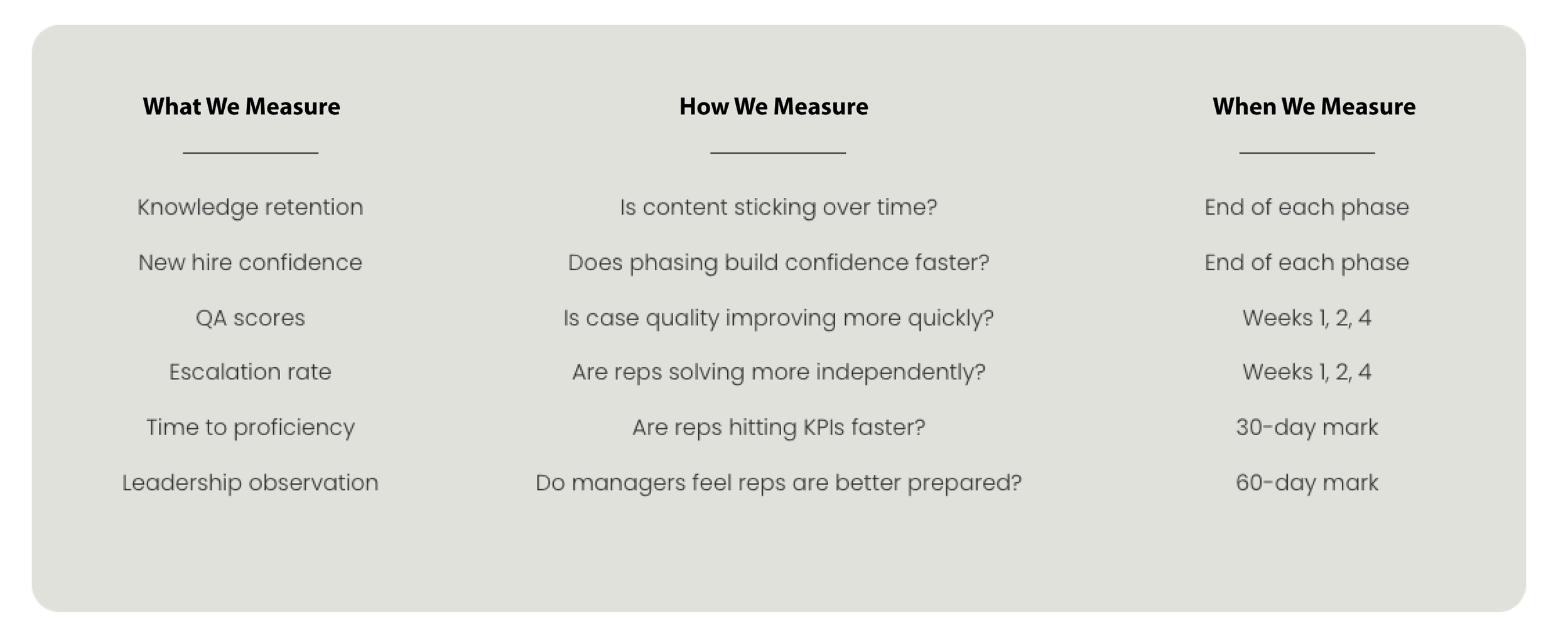
How We Could Measure It
A pilot study with one cohort, tracked against previous cohorts under the current model:
This proposal reflects an instructional and learning experience design ability to look at a performance problem, trace it back to a structural cause, and design a solution that addresses the root rather than the symptom. It also reflects a belief that instructional designers should be strategic partners, not just content builders, which means proposing solutions with measurable outcomes and a clear positive impact on organizational needs.
What This Project Demonstrates
Key Skills Demonstrated
Instructional Design · Program Design · Phased Learning · Needs Analysis · Adult Learning Principles · Cognitive Load Theory · Experiential Learning · Spaced Practice · Data-Driven Evaluation · Stakeholder Communication · Independent Initiative