Case Study:
eLearning Module for Internal Repair Case Transfers
Overview
After completing my contract as a Delivery Specialist, I noticed a gap once reps moved from training to the floor. Case transfers to our internal repair teams were being mishandled. Reflecting on it, the root cause pointed back to onboarding: no specific process for these case transfers had been taught in-depth. Reps weren't making mistakes because they weren't trying, they were making mistakes because they were never given the information to do it correctly.
I designed and built a self-directed eLearning module in Articulate Rise to close this gap. I led this project independently, from problem identification through to final build, applying the ADDIE model to guide every stage of development.
This was a knowledge problem, not a performance one. The case transfer process was never covered in-depth during onboarding, which meant new reps were left to figure it out once on the floor.
The result was a pattern of preventable errors: cases transferred to the wrong repair team, transferred at the wrong time, or missed altogether because reps lacked the training to do it correctly. Each mistake delayed our repair resolution SLA, creating a negative downstream experience for the guest.
The fix wasn't more supervision. It was clear information, delivered before reps hit the floor and grounded in the real situations they'd encounter the moment training ended.
The Problem
I identified this gap independently through direct observation and feedback I witnessed new reps receiving on the floor. Drawing on over a year of AfterSales experience and my role facilitating the 2025 Peak Season new rep onboarding, I served as both the Subject Matter Expert and instructional designer, owning the project from analysis through final development in Articulate Rise.
My Role
The Solution
Action Map
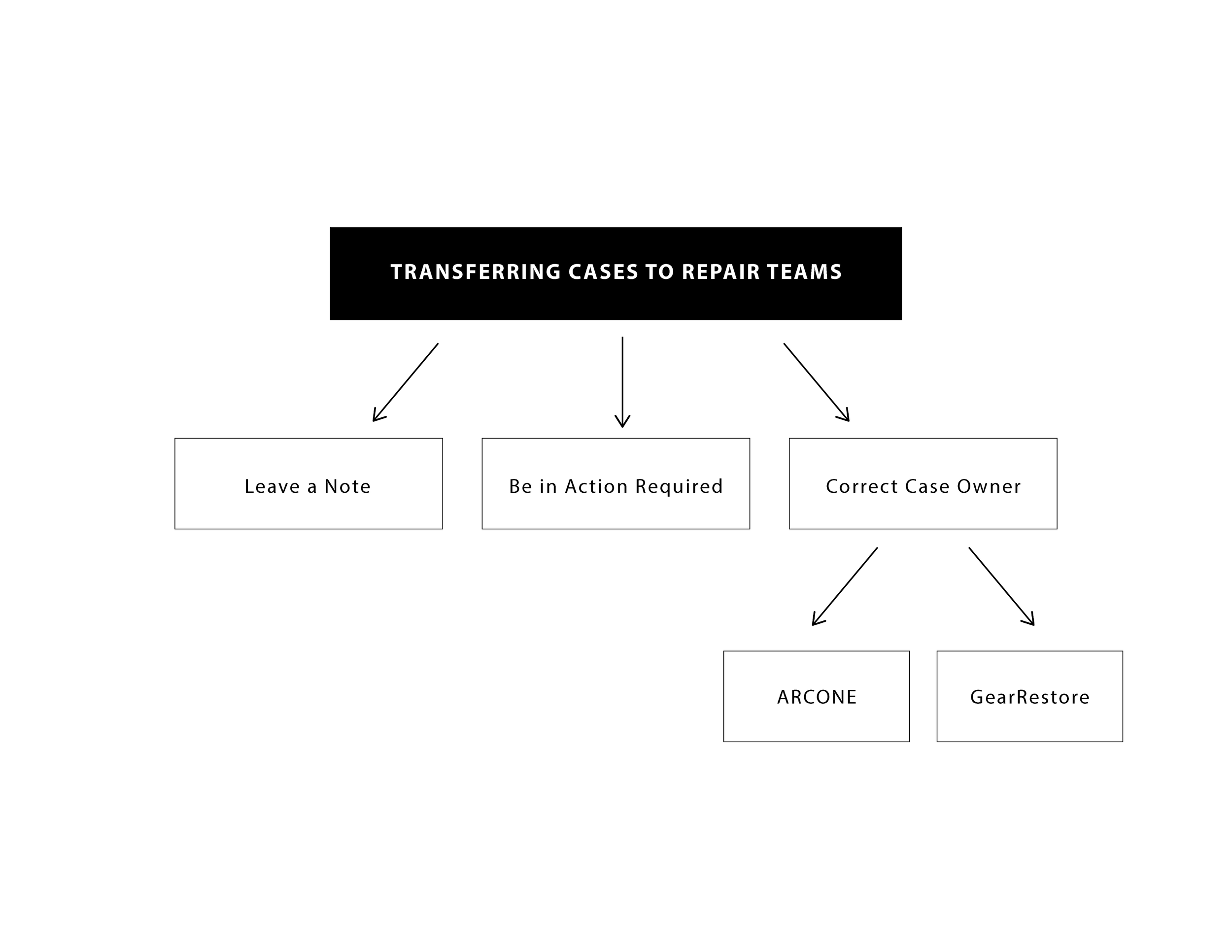
My process began with building an action map to identify exactly what reps needed to do to successfully transfer a case to an internal repair team. This step was critical for cutting through the noise and focusing the eLearning on behaviour, not just content.
The action map revealed that only three core actions were essential to a successful transfer. Those three actions became the foundation of the entire eLearning experience and directly shaped every subsequent content and design decision.
Storyboard
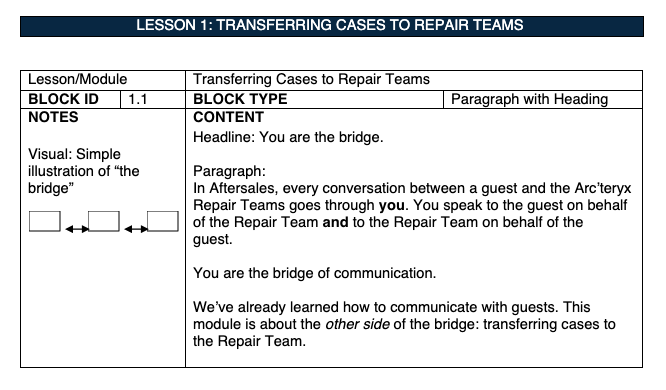
With the action map as my guide, I developed a full text-based storyboard, including scripting the content, sequencing the flow, and mapping out visual placeholders before touching any development tool.
I developed a three-step transfer framework that gave reps a clear mental model to action for every case transfer to an internal repair team. Several intentional design decisions were made during this stage, each grounded in established learning theory:
Opening with a creative hook (Schema Theory)
I opened the module with a self-created metaphor: "You are the bridge." Before introducing a single step, I wanted to give learners a mental model they could anchor the entire process to. This decision draws on schema theory, the idea that learners retain new information more effectively when it connects to something they already intuitively understand. The bridge metaphor gave learners an orienting framework, functioning as what Ausubel would call an advance organizer: a conceptual hook that makes everything that follows easier to absorb and remember.
This decision was also grounded in Malcolm Knowles' adult learning principles: adults engage more deeply when they understand the why behind what they're learning, and leading with a meaningful metaphor established that relevance immediately.
Leading with real-world consequences (Situated Learning)
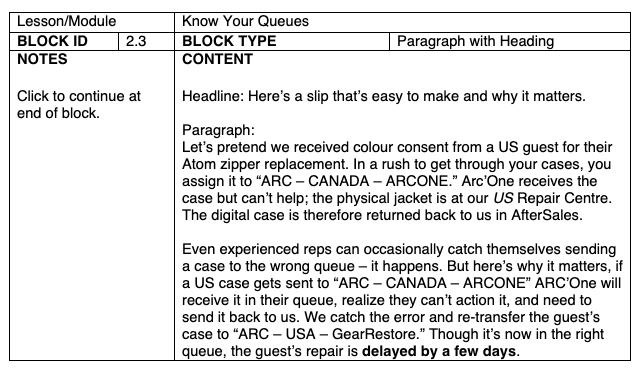
Rather than focusing only on procedural steps, I made a point to also include the actual impact of incomplete transfers, including delayed SLAs and frustrated guests. This decision was informed by Lave and Wenger's situated learning theory, which holds that learning is most effective when it is grounded in the real context where it will be applied. By showing learners the stakes of the environment they were about to enter, I increased both the relevance of the content and the motivation to retain it.
Distributing knowledge checks (Retrieval Practice & Spaced Learning)
Rather than saving the assessment for the end of the module, I embedded knowledge checks throughout the eLearning. This was one of the most deliberate structural decisions in the entire project, grounded in retrieval practice theory. Roediger and Karpicke's research demonstrates that the act of retrieving information, being tested on it, not just reading it, is in itself one of the most powerful mechanisms for long-term retention. Each knowledge check wasn't just a comprehension gate; it was a learning event in its own right, reinforcing the content at the moment it was most fresh and building the retrieval pathways learners would need to act confidently on the floor.
Visual Design
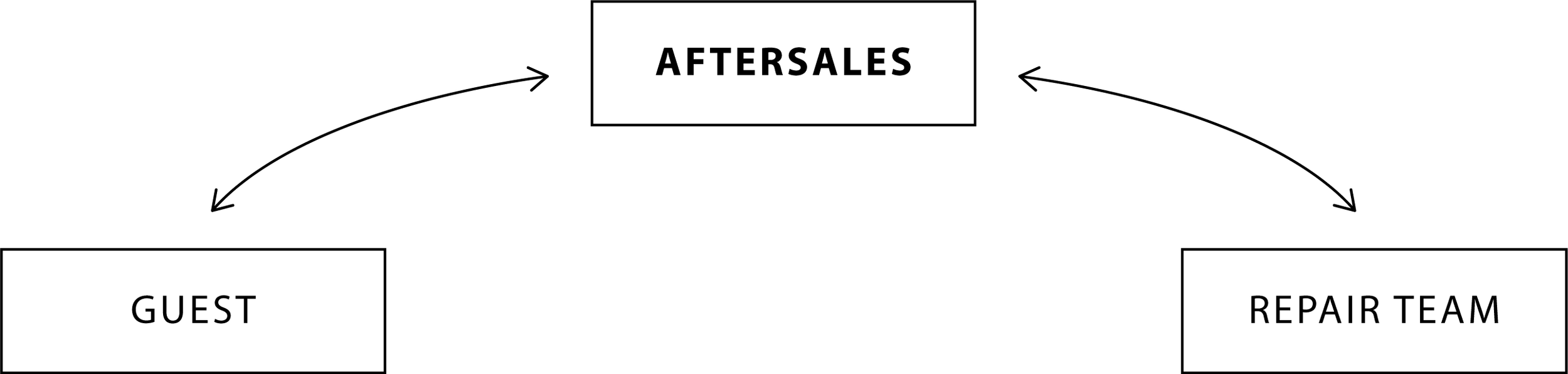
After finalizing the storyboard, I designed three custom illustrations in Adobe Illustrator to visually reinforce the key concepts in each section of the module.
This decision was grounded in Paivio's Dual Coding Theory, which holds that verbal and visual information are processed through two separate cognitive channels and that learning is significantly stronger when both channels are activated simultaneously. Rather than relying on text alone to carry the instructional load, pairing written content with purposeful illustration means learners encode the information twice: once verbally, once visually. Mayer's multimedia learning principles build directly on this foundation, and the practical implication for this module was clear, show the concept, don't just describe it.
Each illustration was designed to be clean and professional, with strong contrast to support accessibility and readability across different viewing contexts. See example below.
Full Development
With the storyboard and visuals complete, I built the final module in Articulate Rise using our pre-established Guest Service templates to ensure consistency and professionalism with existing organizational content.
Throughout the build, every layout decision was filtered through Sweller's Cognitive Load Theory, the principle that working memory is limited, and that good instructional design carefully manages what it asks learners to hold at once. Breaking the transfer process into three discrete, sequenced actions rather than presenting the full process at once directly manages intrinsic load.
The deliberate use of white space, generous padding, and a clean visual hierarchy further reduced extraneous load, preventing the interface itself from competing for cognitive bandwidth that learners needed for the content.
The result was a module that felt calm and navigable, where attention could stay on what mattered.
To evaluate the module, I asked an individual outside of the Guest Services team, with no prior Arc'teryx training, to complete the eLearning from scratch.
The goal was to simulate the new rep experience and assess not just whether the content was understood, but whether it was the kind of understanding that would transfer to real action on the floor. Their feedback confirmed that the module felt clean, professional, and easy to follow. They specifically noted that the "You are the bridge" metaphor immediately landed well, and that the way content built upon itself made the process feel logical and approachable rather than overwhelming, which is exactly the conditions needed for learning to transfer beyond the classroom.
Testing & Results
The module is currently being pitched to leadership for inclusion in the onboarding curriculum.
Once adopted, the module is designed to function as an onboarding resource for new reps, giving the organization a reusable asset that addresses a recurring, costly problem at its root.
Anticipated Impact
This project reflects an end-to-end instructional design process: gap identification, action mapping, storyboarding, visual design, eLearning development, and user testing, initiated independently, without a formal assignment.
More than the process, it reflects a design philosophy: that every structural, visual, and sequencing decision in a learning experience should be intentional. From the opening metaphor to the integrated knowledge check, each choice in this module was made in service of one goal: building the kind of understanding that doesn't stay in the module, but effectively transfers to the floor.
What The Project
Demonstrates
Key Skills Demonstrated
Instructional Design · ADDIE Model · Needs Analysis · Action Mapping · Storyboarding · eLearning Development · Articulate Rise · Adobe Illustrator · Scenario-Based Learning · Adult Learning Principles · Cognitive Load Management · Visual Design · Independent Project Management